 |
This
section of our website is dedicated to the fine artists
in our time. We have found these magnificent pieces to be superb
in craftsmanship and artistry.
If you
need our assistance in any of the items, please send us email.
|
|
This
section of our website is dedicated to the fine artists
in our time. We have found these magnificent pieces to be superb
in craftsmanship and artistry.
If you
need our assistance in any of the items, please send us email.
|

Presenting ...

Susan Kliewer is not only a
Buckaroo, having appeared with us in several films and commercials, but
is a nationally known sculptor. Her medium is bronze and we are proud to
present her work to the discriminating Western art collector.
"GROUND TIED"
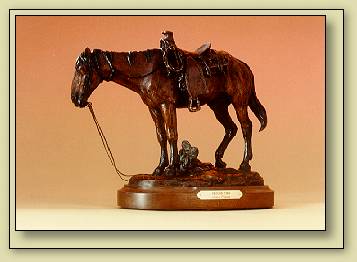
Limited edition of 50
14"W x 12"L x 6"D $2,200.00
(order # SK 1)
The horse Peaches was used by fellow Buckaroo Sam Dolan
in Tombstone and many commercials. The saddle is a Frank Costanza
Texas Hope (see our Saddle section). Susan made the bronze from photos
taken on the set. A special addition to your Tombstone collection.
"SILENCE"
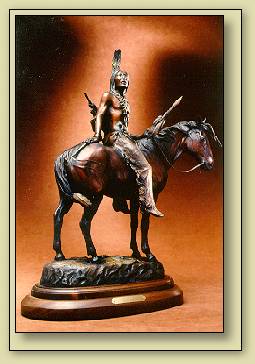
Limited edition of 35
22"H x 18"L x 12"D $3,800.00
(SOLD OUT)
The warrior waits and listens. He�s not sure for what.
Will it be pony soldiers approaching? The crunch of wagon wheels on the
hard, grassy ground or the distant rumble of countless buffalo hooves on
the vast plains beyond the next rise? Or is it just the silence?
"THE POT WRANGLER"
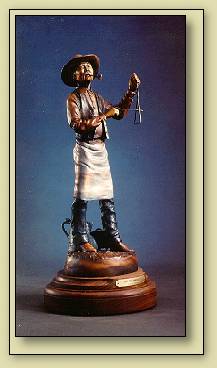
Limited edition of 45
19"H x 8"W x 8"D $3,600.00
(order # SK 3)
I t was chuck-time on the round up, and we heard the Pot
Wrangler shout, "You�d better come and get this or I�ll throw the whole
thing out." So we headed for the wagon like a wild stampeding herd. Fearful
every minute lest the cook might keep his word.
"NAVAJO SPORT"
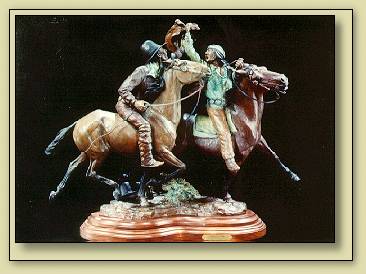
Limited edition of 35 - 3 remaining
28"L x 22"H x 10"D $5,800.00
(order # SK 4)
The "Chicken Pull" is an old game. As Navajos had few
chickens, a burlap sack was used as a substitute. The riders lean from
the saddle to grab the exposed corner of the buried burlap sack and a free-for-all
ensues. The Navajo people love these games, with plenty of side bets and
wild horsemanship.
"Kinaalda - Coming of Age"
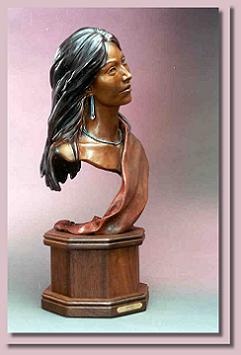
27"H x 11"D $4,300.00
(order # SK-5)
The Navajo have related the story of Changing Women for generations.
Born of the mingling of darkness and dawn, she was adopted by First Man
and First Woman. When she reached maturity four days after birth, her parents
arranged a Kinaalda, a Coming of Age ceremony. The direct translation of
Changing, Woman's Navajo name is "Woman She Becomes Time and Again," indicating
the perpetual cycle that is celebrated at every Kinaalda.
"THE SINAGUA"
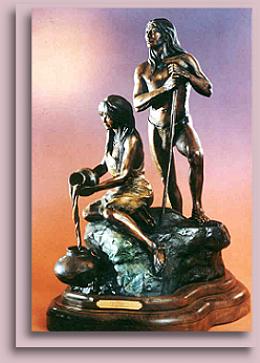
22"L x 23"H x 16"D $3,600.00
(order # SK-6)
AROUND A.D. 1090 - A.D. 1450, THE SINAGUA PEOPLE LIVED IN CENTRAL AND NORTHERN ARIZONA.
DESPITE THEIR NAME, WHICH MEANS "WITHOUT WATER" IN SPANISH, THE SINAGUA HAD WATER IN ABUNDANCE AND WERE SUCCESSFUL FARMERS,
ARTISANS AND TRADERS. HOWEVER, IN A.D. 1450, THE SINAGUA DISAPPEARED FROM ARCHAEOLOGICAL RECORD. THE MYSTERY OF WHERE THEY
WENT MAY NEVER BE SOLVED.
Note: A lifesize version is available for $55,000.00.
"WOMEN OF BOSQUE REDONDO"
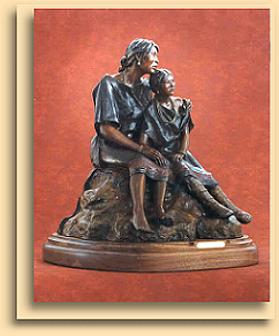
21"W 23"H x 18"D $4,900.00
(order # SK-7)
"In 1863 The United States Govn't sent Kit Carson and an army of seven hundred well armed men into the Navajo country~to force the Dine'to surrender to military rule. The Navajo were sent to Bosque Redondo, where Fort Sumner was built. I was inspired by several old photographs taken of the Navajo women at the that, time. They seem to capture the strength and endurance of the Navajo people during that dark period in American history."
Canyon de Chelly The Long Walk
Ganado Mucho, a Navajo chief captive at Fort Sunmer, asking for the return of his people to the Dine Bikeyah.
"Let us go home to our mountains.
Let us see our flocks feeding in the valleys, and let us ride again where we can smell the sage and know of the hidden hogans by the smell of pinon smoke.
Let us go where we can build our homes in solitude and privacy and live again as men, not animals.
Let us be free to build a better way of life and learn to live in peace where the red buttes rise from the desert sands, and eagles sweep across the sky ....
Here we have nothing. Our children grow up in ugliness and death.
Let us go home."
At dawn on June 18, 1868 the Navajos left Fort Sumner, heading back to the Dine Bikeyah.
Many years later, an old Navajo chief recalled that moment: "When we saw the top of the mountain from Albuquerque we wondered if it was our mountain, and we felt like talking to the ground, we loved it so. "
"A Nation is not defeated until the hearts of their women are beaten."
To place your order, just
open the door handle!